Partner Q & A: The role of midwives in reducing maternal and newborn mortality

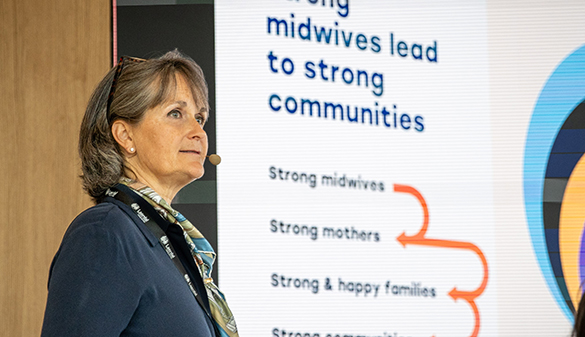
Professor Jacqueline Dunkley-Bent is the first Chief Midwife appointed by the International Confederation of Midwives. Jacqueline is responsible for championing the interests of midwives globally, elevating the professional profile, and emphasizing the significant benefits of a well-resourced, educated, regulated, and empowered midwifery workforce. Prior to that post, she served as England’s first Chief Midwifery Officer. At ICM, Jacqueline leads initiatives essential to the growth of midwifery, globally.
Progress on maternal and newborn mortality remains deeply uneven. While notable improvements have been achieved in some countries, rates remain unacceptably high in many low-resource and fragile settings, where health systems face persistent constraints. At the same time, the stagnation and in some cases reversal of outcomes in certain high-income countries shows that these challenges are not limited to resource shortages alone, but also reflect systemic gaps in the quality, accessibility, and equity of care. Together, these trends highlight the urgent need for sustained, system-wide investment and a renewed focus on delivering high-quality, respectful care for all women and newborns.
Midwives are central to reducing maternal and newborn mortality and are widely recognized as essential to achieving sustainable improvements in health outcomes. When they are appropriately educated, effectively regulated, and fully integrated within functioning health systems, they can deliver approximately 90% of essential sexual, reproductive, maternal, newborn, and adolescent health (SRMNAH) services across the continuum of care. This includes not only safe, evidence-based clinical care, but also respectful, person-centered approaches that uphold dignity, autonomy, and continuity.
The evidence behind ICM’s campaign, “One Million More Midwives” demonstrates the transformative potential of scaling midwifery models of care. Expanding the global midwifery workforce is associated with substantial reductions in preventable mortality and morbidity, while also strengthening health system efficiency and equity. Adding one million more midwives by 2035 could prevent an estimated 67% of maternal deaths, 64% of newborn deaths, and 65% of stillbirths, equating to approximately 4.3 million lives saved.
These figures show that investing in midwifery is not only a workforce priority, but one of the most effective and evidence-based strategies for improving survival and advancing quality of care for women, newborns, and communities worldwide.
Improving quality care for mothers and newborns requires a comprehensive, system-wide approach grounded in a strong and supported health workforce. At its core are skilled health workers, particularly midwives, who are educated to international standards, appropriately regulated, and enabled to practice the full scope of their competencies. Midwifery-led continuity of care is a critical model, associated with improved clinical outcomes, better patient experience, and more efficient use of health system resources.
Equally essential is respectful, person-centered maternity care that upholds dignity, autonomy, and human rights at every stage of the care journey. These elements must be underpinned by well-functioning health systems that ensure adequate staffing levels, supportive working environments, effective referral pathways, and access to essential medicines, equipment, and infrastructure.
The United Nations Population Fund investment case for midwifery makes clear that strengthening the midwifery workforce is one of the most impactful and cost-effective strategies available to improve quality of care globally. Strategic investment in midwives across education, regulation, and deployment not only reduces maternal and newborn mortality and stillbirths, but also advances equity, strengthens health systems, and delivers long-term social and economic returns.
Competency-based education, grounded in the Essential Competencies for Midwifery Practice, ensures midwives are trained to perform essential clinical skills safely and confidently. Simulation-based training complements this by allowing them to practice managing complications in realistic, low-risk environments. Together, these approaches strengthen clinical judgement, improve preparedness, and directly contribute to safer maternal and newborn outcomes.
The rise in maternal mortality in some high-income countries, including the United States, shows that progress is neither linear nor guaranteed. It highlights the need to look beyond resource availability alone and examine how care is organized, delivered, and experienced.
High-income countries can learn a great deal from low- and middle-income countries that have made sustained progress by prioritizing midwifery-led models of care, prevention, and community engagement. For example, Sri Lanka has achieved significant reductions in maternal mortality over several decades through consistent investment in a strong, community-based midwifery workforce, integrated referral systems, and universal access to care. These approaches emphasize continuity, early intervention, and trust in midwives as primary providers of care.
This demonstrates that improved outcomes are not solely dependent on advanced technology or high levels of intervention, but on coherent, people-centered systems in which midwives are fully educated, regulated, and integrated into care pathways. For high-income settings facing fragmentation and over-medicalization, these models are a strong reminder that strengthening midwifery, continuity of care, and equity-focused service delivery can be central to reversing negative trends and improving maternal and newborn outcomes.
Greater adoption of the midwifery model of care depends on sustained political commitment, strategic investment, and coordinated system-wide action. Governments must priorities midwifery within national health strategies, strengthening education, accreditation, and regulatory frameworks so midwives are prepared and authorized to practice to the full scope of their competencies. This must be matched by enabling work environments, alongside stronger integration of midwives within multidisciplinary teams and referral systems that support continuity and quality of care.
Addressing workforce shortages is equally critical. Targeted investment in the recruitment, education, and retention of midwives, particularly in underserved and fragile settings, is essential to expanding access to midwifery-led care. The One Million More Midwives campaign highlights that closing the global midwifery gap is not only a workforce priority, but a proven strategy for improving maternal and newborn outcomes at scale, while advancing more equitable, effective, and sustainable health systems.
National midwifery associations are fundamental to advancing the profession and improving the quality of care globally. Strengthening them requires sustained investment in institutional capacity, including robust governance structures, effective leadership development, and reliable, long-term funding. Well-resourced associations are better positioned to support their members, uphold professional standards, and contribute meaningfully to education, regulation, and workforce development.
Stronger capacity also enables greater advocacy and policy influence at national and global levels. By engaging effectively with governments, partners, and international initiatives such as the petition for more midwives, national associations can help shape enabling policy environments, promote evidence-based practice, and ensure that the voice of midwives is consistently represented in decision-making. In doing so, they play a critical role in strengthening the profession and advancing maternal and newborn health outcomes worldwide.
The message is simple: investing in midwives saves lives. This is not aspirational, it is grounded in strong global evidence. When midwives are educated to international standards, supported in enabling work environments, and fully integrated into health systems, they can deliver the majority of essential care needed to prevent maternal and newborn deaths and stillbirths, while also improving the quality, safety, and dignity of care.
This is the foundation of the campaign for more midwives, which shows that scaling the midwifery workforce is one of the most effective and equitable strategies available to improve outcomes worldwide. Investing in midwives is not only a health priority; it is a strategic, evidence-based decision that strengthens health systems, advances gender equity, and delivers lasting benefits for women, newborns, and communities.
International Confederation of Midwives amplifies the impact of its work through strategic partnerships at global, regional, and national levels. Central to this approach is close collaboration with national and regional midwives’ associations, which are key partners in advancing the profession, strengthening professional leadership, and ensuring that the voices of midwives are represented in policy and decision-making. In addition, ICM works with governments, United Nations agencies, non-governmental organizations, and civil society to align efforts across the health system.
Through these partnerships, ICM supports the alignment of policy, investment, and practice with global standards and evidence. By convening stakeholders, advancing advocacy, and strengthening the capacity of midwives’ associations, ICM helps translate global commitments into country-level action, expanding access to quality, midwifery-led care and improving outcomes for women, newborns, and communities worldwide.
Partnerships need to become more ambitious, coordinated, and investment-focused to meet the scale of global need. Expanding the midwifery workforce requires collaboration between governments, academic institutions, midwives’ associations, and international partners to strengthen education systems, increase training capacity, and ensure alignment with global standards. This includes investing in faculty development, accreditation mechanisms, clinical training sites, and digital and simulation-based learning approaches to reach more students without compromising quality.
At the same time, partnerships must extend beyond education to support effective deployment, retention, and career progression. Aligning workforce planning with health system needs, creating enabling work environments, and ensuring sustainable financing are all critical to training and retaining the nearly one million additional midwives required globally. Through coordinated action and shared accountability, these partnerships can help build a competent, well-supported midwifery workforce capable of delivering high-quality care for women and newborns everywhere.
My foremost aspiration is universal access to high-quality, competency-based midwifery education that is fully aligned with international standards. This means education systems that are adequately resourced, consistently regulated, and accessible to all who wish to enter the profession, regardless of setting. Such programs must be grounded in evidence, delivered by well-prepared faculty, and supported by robust accreditation and quality assurance mechanisms.
Equally important is the integration of education with strong clinical learning environments, ensuring that every graduate midwife is not only knowledgeable but fully prepared for practice. This includes meaningful, well-supervised clinical placements, exposure to midwifery-led models of care, and the development of critical thinking, clinical judgement, and respectful, person-centered approaches. Together, these elements would ensure that every midwife enters the workforce ready to deliver safe, effective, and dignified care for women and newborns everywhere.