How the Safer Births Bundle of Care Is Improving Outcomes in Nigeria

Berhanu Haile Nigatu is Country Director for Norwegian Church Aid in Nigeria, with more than 10 years of leadership experience in humanitarian and development programs across Africa.
Statistics show that maternal and newborn mortality is the highest in Nigeria. The contributing factors are displacement due to conflict, inadequate health facilities in conflict areas, and limited health staff in remote locations. Antenatal care, skilled birth attendance, and postnatal care coverage is low, leaving many women to deliver at home without trained support. Funding gaps further compound these issues, as significant shortfalls have restricted the scale and reach of maternal and newborn health interventions.
The Safer Births Bundle of Care (SBBC) is an evidence-based maternal and newborn health initiative designed to reduce preventable maternal and neonatal deaths during childbirth by strengthening the skills, confidence, and performance of healthcare workers. The program integrates innovative clinical tools, simulation-based training, continuous quality improvement processes, and active engagement of health workers. As the grant manager for the NORAD-funded project, NCA has been responsible for day-to-day coordination with health staff in the targeted facilities and for overseeing implementation across the six participating health facilities.
The Safer Births Bundle of Care has been implemented in Borno State for about one and a half years now, and what stands out most to me is that we are not just seeing better health outcomes, we are seeing more confident health workers. Midwives and frontline staff are better prepared to respond when every second counts, and that gives mothers and families a much better chance of going home together.
What has exceeded my expectations is how quickly these improvements have taken root. We knew the approach had great potential, but seeing such remarkable progress in a challenging setting like Borno has been truly inspiring. It has shown that when health workers are equipped with the right skills, tools, and ongoing support, they can save lives and transform the quality of care. That is something we are incredibly proud of.
One story that has stayed with me is that of Hadizah Abdulrahman, a young internally displaced mother in Maiduguri, and her daughter, Rahama. Hadizah had previously lost a baby after prolonged labor at home. So, when she arrived at Yerwa Primary Health Centre for the birth of her next child and her newborn was delivered limp and unresponsive, she feared she was about to experience the same heartbreak all over again.
But this time, the outcome was different.
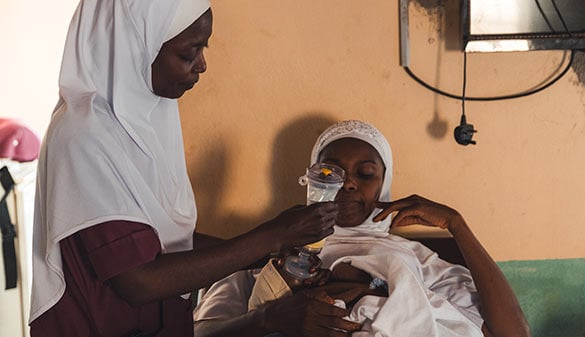
The attending Community Health Extension Worker had been trained through the Safer Birth Bundle of Care program and immediately began newborn resuscitation using the skills and equipment available in the delivery room. The team worked relentlessly, ventilating the baby with the upright bag and mask, clearing the airway with the Penguin suction device, and carefully monitoring the baby's condition. After nearly an hour of determined effort, the room was filled with the sound everyone had been hoping for, Rahama's first cry.
For Hadizah, that cry meant everything. It meant she would not leave the health facility empty handed again. Her husband later said that hearing his daughter had survived brought overwhelming relief and gratitude. Stories like Rahama's remind us that every statistic we report represents a real family whose life has been forever changed. When we say newborn deaths have been reduced or resuscitation outcomes have improved, we are talking about mothers who return home with healthy babies in their arms, fathers who are spared unimaginable loss, and health workers who have the skills, confidence, and tools to save lives when every second matters.
Rahama's story captures the essence of why this partnership matters. It shows how investing in frontline health workers through training, mentorship, and lifesaving innovations can transform what could have been a tragedy into a story of hope. For me, it is a reminder that the true impact of the Safer Births Bundle of Care is measured not only in numbers, but in the lives, families, and futures that are preserved.
The onsite low-dose, high-frequency learning approach has been particularly effective because it gives healthcare workers regular opportunities to learn, practice, and apply new skills in their daily work. It also creates space for reflection and continuous improvement, allowing participants to build on their experience with each learning cycle.
Beyond strengthening clinical competencies, the repeated interactions and collaborative nature of the training have helped develop important leadership and interpersonal skills, such as active listening, communication, and teamwork. We have also observed a noticeable increase in the confidence of midwives and frontline health workers. This is not only due to improved knowledge and skills, but also because they have access to the essential clinical equipment and materials needed to provide quality care. Knowing they are well trained and adequately equipped has increased their sense of preparedness and professional fulfillment in supporting mothers and newborns.
Given the contextual challenges in Borno, the Safer Births program has taken a phased and adaptive approach to implementation. The pilot phase was intentionally conducted in Maiduguri, where the security situation is relatively stable, and all six pilot health facilities are located within the city. This strategic decision helped minimize operational disruptions and ensured that healthcare workers could participate fully in training, mentorship, and quality improvement activities.
As we prepare for scale-up, we are conducting comprehensive risk analyses and developing robust mitigation measures to address anticipated security, access, and operational challenges. This approach will enable us to expand the program while safeguarding both service quality and the continuity of maternal and newborn healthcare services.
The Safer Births Bundle of Care has made its greatest impact by improving the ability of healthcare workers to identify and respond to complications during labor and immediately after birth, when the risk to both mother and newborn is highest. At the start of the project, participating facilities recorded significant gaps in intrapartum monitoring and newborn care, with 117 fresh stillbirths and a stillbirth rate of approximately 25 per 1,000 births. Through the introduction of innovative tools such as Moyo for fetal heart rate monitoring and NeoBeat for rapid newborn assessment, combined with regular simulation-based training and mentorship, healthcare workers were able to detect complications earlier and intervene more effectively. As a result, fresh stillbirths fell to approximately 23 cases, and the stillbirth rate declined to about 8 per 1,000 births, representing an estimated 68% reduction.
The project has also contributed to substantial improvements in maternal outcomes. The Maternal Mortality Ratio decreased from approximately 508 to 234 deaths per 100,000 live births, significantly exceeding the project's target of a 30% reduction. Beyond the quantitative results, healthcare workers consistently report greater confidence in managing obstetric and neonatal emergencies, improved clinical decision-making, and stronger teamwork during critical situations. These improvements have translated into faster and more effective care for mothers and newborns, demonstrating how the Safer Births Bundle of Care is strengthening both individual competencies and the overall quality of care within health facilities.
Beyond the impressive clinical outcomes, the SBBC program has driven meaningful changes at the health facility level. Health workers have reported improvements in documentation and record-keeping practices, resulting in more reliable data and greater use of evidence for decision-making and quality improvement. The program has also strengthened mentorship and supportive supervision systems, enabling continuous skills development and reinforcing adherence to best practices in maternal and newborn care.
In addition, SBBC has fostered stronger teamwork and communication among healthcare providers, particularly during obstetric and neonatal emergencies. The use of regular simulation-based training has improved coordination, role clarity, and collective problem-solving, while also increasing staff confidence and leadership capacity. These changes have contributed to a culture of continuous learning, accountability, and quality improvement within participating facilities. As a result, health facilities are not only better equipped to manage complications but are also becoming more resilient, data-driven, and patient-centered in their approach to maternal and newborn care.
Sustainability was a key consideration from the design phase of the SBBC project. Rather than creating parallel systems, NCA implemented the project through existing health facilities and worked closely with government health authorities and frontline health workers to strengthen local capacity and ownership.
A major focus has been on transferring knowledge and skills through continuous simulation-based training, mentorship, and supportive supervision. By equipping healthcare workers with practical competencies and providing essential training materials and equipment, we have helped embed these practices within routine service delivery.
The innovative SBBC tools are easy to use, durable, and designed for long-term applications in low-resource settings. Their simplicity and resilience reduce the risk of breakdowns and ensure continuity of care. To further strengthen sustainability, NCA and its partners trained Biomedical engineers who will maintain and repair the equipment, ensuring that devices last longer and can be serviced locally.
In addition, NCA has actively engaged government stakeholders at state and health facility level, advocating for the integration and scale-up of the SBBC approach within public health systems. We have also encouraged the allocation of government resources to support the continuation and expansion of these interventions. By strengthening local ownership, institutionalizing capacity-building approaches, and promoting government investment, the improvements achieved through the project can be sustained well beyond the funding period.
An important lesson from the program is that it is important to address broader logistical and health system challenges that affect safe delivery. This includes improving health facility infrastructure and ensuring the consistent availability of essential equipment and supplies required for quality maternal and newborn care.
We have also learned that maintaining the motivation of healthcare workers is critical to sustaining improvements. Regular coaching, mentorship, and supportive supervision help reinforce skills, encourage adherence to best practices, and foster a culture of continuous learning and quality improvement. When health workers feel supported, equipped, and valued, they are better able to provide safe and effective care for mothers and newborns.
The pilot phase of the Safer Births Bundle of Care was implemented through close collaboration between the Borno State Government, NCA, Laerdal Global Health, and Haydom Lutheran Hospital in Tanzania. Each partner brought unique expertise and experience, which was critical to the successful implementation of the project. We are also deeply grateful to NORAD for funding this life-saving initiative. Their support enabled us to demonstrate the effectiveness of the approach and create a strong foundation for scaling up the program to reach more health facilities, healthcare workers, mothers, and newborns.
My message is that investing in maternal and newborn health is an investment worth making, given the demonstrated results of a significant reduction in maternal and newborn mortality in the SBBC pilot phase. Investing in proven, scalable solutions such as the Safer Births Bundle of Care, taking into consideration the lessons learnt in the pilot phase, we can accelerate progress and ensure that many more mothers and newborns survive and thrive.