Partner Q&A: How innovative financing can accelerate global health progress

About Luc Laviolette
Luc Laviolette, a Canadian national, is the Head of Secretariat for the Global Financing Facility for Women, Children and Adolescents (GFF). Previously, Mr. Laviolette led the GFF’s country programs from 2017-2020. He has played various roles within the World Bank, including leading its human development portfolio for the Maghreb Region and Malta (2020-2022) and for the Central African Republic, Democratic Republic of Congo, and Republic of Congo (2013-2017). Prior to joining the World Bank in 2009, he worked for the Government of Canada, an international non-profit organization, and the International Development Research Center.
When the GFF launched in 2015, it set out with a clear goal: ending the preventable deaths of women, children, and adolescents in countries most impacted by maternal and child mortality.
Now, 10 years later, that mission remains our north star. Working through a country-led model, we’ve seen significant progress over the last decade: all 36 GFF partner countries have reduced maternal mortality, under-five mortality, and adolescent birth rates while expanding access to modern contraceptives. And after years of lagging behind global averages, GFF partner countries are now outpacing other countries in decreasing mortality.
To build on this progress and lessons learned so far, we launched a new five-year strategy in late 2025. The strategy recognizes and responds to today’s increasingly complex global health realities, including shifts in aid and emerging economic, health, and climate threats. It continues to support access to life-saving care while sharpening the focus on health system transformation, sustainability, and domestic resource mobilization. Developed through a collaborative process involving more than 1,100 country and global stakeholders, the strategy also underscores GFF’s role as a key contributor to the World Bank Group's goal of delivering affordable, quality care to 1.5 billion people by 2030.
The GFF is uniquely positioned within the World Bank Group. Our catalytic grants—smaller, strategic investments designed to generate larger funding—help countries commit to investing earlier and at scale to improve the health of women, children and adolescents. The financial leverage and resulting impact are significant. Between July 2015 and June 2025, the GFF mobilized $2.5 billion in grant financing, which unlocked more than $11 billion in World Bank Group resources.
The GFF can also help countries take smarter risks on innovation, with the support of our partners. We’ve seen this, for instance, in our partnership with Laerdal and the Safer Births Bundle of Care initiative in Tanzania.
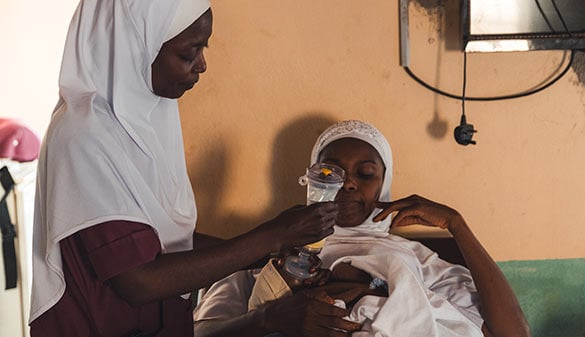
The Safer Births model provides innovative clinical and training tools and frequent, on-site, simulation trainings to help health workers respond more effectively to emergencies during labor and birth. Safer Births is a powerful example of how innovation, when paired with government leadership, strong support, and implementation, can deliver lifesaving impact at scale. The model is the result of more than a decade of research and collaboration among global and local partners, both public and private, including Laerdal Global Health and Haydom Lutheran Hospital in rural Tanzania, where it was first launched with the Tanzanian government.
In 2020, the Safer Births Bundle of Care program received a GFF Innovation-to-Scale award to launch its first phase at 30 facilities across five regions in Tanzania, reaching around 300,000 births over three years. A GFF-supported study published in the New England Journal of Medicine in 2025 revealed remarkable results: over the three-year period, the program achieved a 75 percent drop in maternal deaths and a 40 percent decline in early newborn deaths.
This successful model reflects the GFF’s approach of supporting country-led, evidence-based efforts that strengthen health systems while mobilizing aligned financing and partnerships to scale life-saving innovations sustainably. Replication and scale-up of the Safer Births model is happening in real time: its second phase has been implemented at 142 hospitals across the five regions in Tanzania.
The program is also expanding across the region. Nigeria is adapting Safer Births within its national framework, with two states having begun implementation. In January of this year, government teams from Cameroon, Chad, Côte d’Ivoire, Guinea, Rwanda, and Senegal visited the Haydom Lutheran Hospital to gain hands-on experience in the costing and implementation of the Safer Births approach.
As the Safer Births model demonstrates, partnership with countries in the lead is at the core of the GFF’s work. From our experience of working closely with partner countries, leading donors, and local, regional, and global health institutions, we know the best partnerships are built around a common goal, mutual trust and respect, evidence-based solutions, and a clear understanding of the path ahead. Success requires well-defined roles, sustainable financing, effective communication, and a commitment to learning and scaling up what works.
Investing in the health of women, children, and adolescents is one of the most impactful actions a country can take. More than ever, we need to work swiftly, collaboratively, and with renewed focus to close the gaps. Our efforts will continue to prioritize building and sustaining investments, deepening partnerships, strengthening systems and processes, and scaling proven innovations and solutions that improve lives and create better opportunities for all.
At the GFF, our vision is that every woman, child, and adolescent can access the health care they need to survive and thrive. We dream of countries having sufficient and sustainable financial resources, alongside the political will, to invest in the needs and well-being of women, children, and adolescents. The evidence is clear: lasting impact comes from building strong country-led health systems. Now is the moment to join together to make this a reality.