Empowering Healthcare Providers to Manage Childbirth Emergencies in Liberia
Like many countries, Liberia faces a significant maternal health challenge. In 2020, the maternal mortality rate was 652 deaths per 100,000 live births, which far exceeds the 2030 Sustainable Development Goal target of 70.
Many maternal deaths are linked to complicated deliveries that require necessary emergency caesarean sections. Reducing maternal mortality depends on ensuring maternal safety, prompt clinical decision-making, and the safe implementation of pre-, intra-, and post-operative care during obstetric emergencies. These challenges are especially acute in rural areas, where newly graduated clinicians with limited experience are often expected to perform lifesaving procedures with minimal supervision.
Training opportunities in Liberia remain limited. Few in-service or refresher programs exist to strengthen clinical decision-making or teach procedures for caesarean sections and other essential obstetric skills, including normal delivery, vacuum extraction, management of shoulder dystocia and breech delivery, and recognizing when to escalate to surgery.
Through Laerdal’s Buy One, Gift One (BOGO) program Laerdal partnered with the World Federation of Societies of Anaesthesiologists (WFSA) in a campaign to donate birthing simulators to association member projects in low- and middle-income countries.
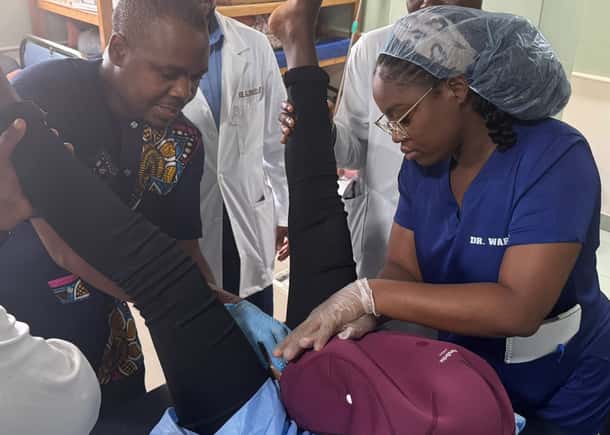
A recent BOGO recipient, a project at the University of Liberia College of Health Sciences, strengthens decision-making and clinical skills across healthcare training. By integrating MamaBirthie simulators into medical and nursing curricula, students learn normal childbirth, recognize indications for cesarean section, and gain hands-on experience before clinical rotations. The initiative aims to support continuous professional development by building both decision-making and practical procedural skills.
Before using the MamaBirthie simulator, I was nervous about managing deliveries. Practicing repeatedly on the model gave me confidence to perform procedures correctly without panicking.
So far, almost 100 healthcare personnel have participated including students, residents, and faculty from medical, nursing, and midwifery programs.
The simulations also help learners overcome fear as a barrier to confidence in real clinical settings.
The simulator let me try, fail, and repeat until I got it right. This improved both my skills and my confidence in assisting normal deliveries.
The program is tailored to learners at their own levels including pre-service learners who are final-year students preparing for clinical work as well as in-service learners such as Interns, obstetrics and gynecology residents, and senior nursing/midwifery staff.
Hands-on practice helped me understand the mechanics of breech childbirth complications far better than reading alone. I feel more competent in recognizing and managing complications while awaiting additional support.
Faculty report improvements among participants, including:
This initiative demonstrates how hands-on, realistic training tools provided through the BOGO program enables clinicians to gain hands-on experience in lifesaving obstetric care in Liberia and beyond.
Project Partners:
University of Liberia, College of Health Sciences, John F. Kennedy Medical Center (JFKMC), Yale University, Vanderbilt University Medical Center, Capacare, WFSA, and Laerdal Global Health.